%20White%20AK%20Small%20Logo.png)
Film Review: Nuremberg (2025)
- Alex Kelaru

- Nov 30, 2025
- 3 min read
Russell Crowe playing Hitler’s right-hand man. That alone makes this mandatory viewing.
This film tells the story of the Nuremberg trials that started in 1945 at the end of the Second World War. It focuses on the German leadership that was captured and brought here for a fair trial, among them the Reichsmarschall Hermann Göring played by Russell Crowe. The story is based on the book The Nazi and The Psychiatrist by Jack El-Hai and we step behind the scenes of this trial through the psychiatrist Douglas Kelley, played by Rami Malek and to an extent through the Chief US prosecutor Robert Jackson, played by Michael Shannon.
The film is directed by James Vanderbilt, who was the writer of Zodiac, the 2007 film made by David Fincher.
So, with all this top-notch cast and sensitive topic, is the film worth the ticket price? The simple answer is: YES, it is.
At its core and as expected, this is a court drama at a time when the world was still in shock at the end of five years of terror and trauma instilled by the Nazi regime. In the chaos that followed, many members of the Nazi High Command tried to escape or committed suicide, but some were captured during their escape attempts.
The architect of these trials, was Robert H. Jackson, who had to shape the overall legal strategy for the Allies, in particular the framework for the four main charges. Some of those charges were crimes against humanity and war crimes. In the legal world, Jackson is well known, but outside of the courtroom maybe less so. Either way, the importance of Jackson is undeniable: besides his historical cross-examinations of Göring, he pushed for a rule-based tribunal instead of executions, like the Allies wanted. He also advocated for the idea that in aggressive war, individuals, not just states, must answer for their crimes. His work became the foundation for later tribunals in Yugoslavia and Rwanda and even the International Criminal Court.
In the film, Jackson is one of the main characters, as well as the psychologist Douglas, played by Rami Malek. Now, Douglas is the one who spends the most time with Göring and it is his job to help uncover Göring’s defence and help Jackson dismantle it.
As Reichsmarschall during the war, Göring was the second in command after Hitler. His importance in the Nazi regime was immense. Besides being Hitler’s officially named successor, he was highly intelligent. He built the German Air Force early in the war, which led to numerous victories; he founded the Gestapo, the Nazi secret police; he controlled industrial war policy and the war economy. And, the main topic of this film, he signed off the order that enabled the ‘Final Solution’ instructing Reinhard Heydrich to commit genocide.


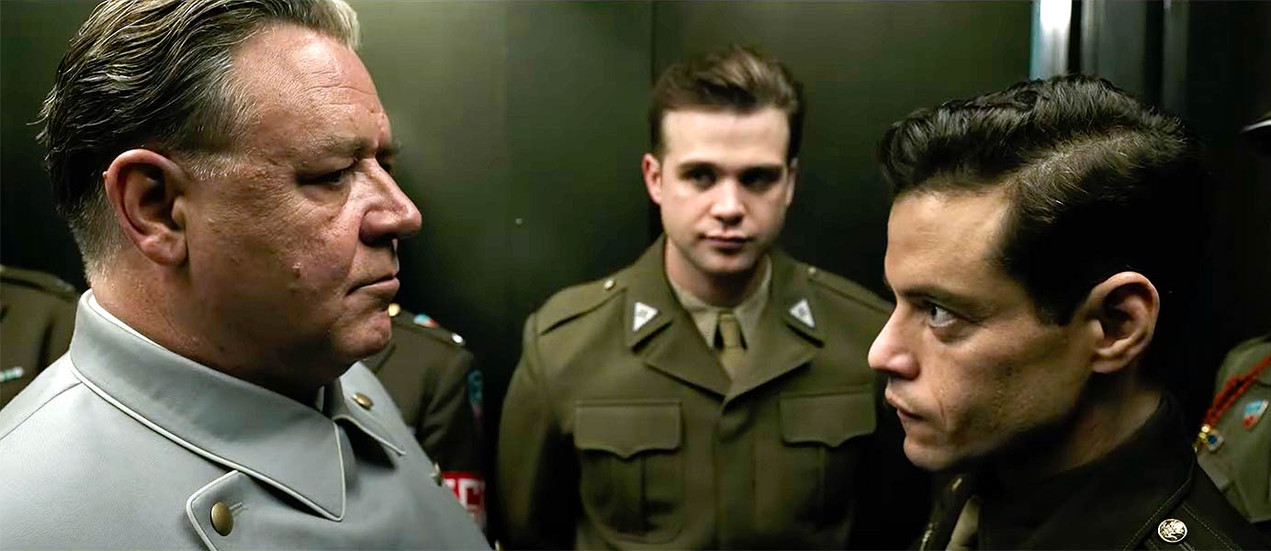


The best parts of this film are the scenes with Göring in them. Russell Crowe still has the acting skills, and the bravery to be honest, to go under the skin of such a monstrous person. A figure like Göring was not just a man of power, but a man who represented an entire empire and had the mindset required to build an empire on manipulation and extermination. Getting under the skin of such a man requires skill and I would think could be dangerous considering the radically different way of thinking these war criminals had to possess in order to commit the crimes they did. In addition, Göring put on a show during the trials and tried to manipulate everyone using his charm, being evasive with his answers and trying to control the narrative. He bluntly denied that he knew about the 1200 concentration camps and blamed everything on Himmler, the head of the secret police.
These many layers of Göring’s personality are clear in the film and in Russell Crowe’s performance and they are quite a feast for the eyes.
The only issue I had was that, even at two hours and thirty minutes long, the film tries to achieve too much and loses focus a bit. Maybe it is the scale of the topic and the number of historically important events that it is trying to tell, but by the end it felt like not enough time was spent with Göring and the psychiatrist, or not enough with prosecutor Jackson, which does not help the film.
There is another storyline involving the translator Howie, who translates for Göring, himself a Jew whose parents disappeared in the camps, but that was not needed and was distracting, occupied screen time that could have been given to the main characters.
Either way, this is a powerful film, built specifically for strong performances and everyone involved does a great job with the time they are given. It includes some archival footage from the camps, so bear that in mind as those images are quite horrifying.
Overall, definitely worth the ticket price.